Street names are the neighborhood's oldest storytellers. Tap any street below to uncover who, or what, gave it its name.
William H. and Caleb O. Halsted were Philadelphia bankers who helped finance Mayor William Ogden's real estate ventures in early Chicago.
The street was not always Halsted. It was first called First Street, then Dryer Street, before taking the name it holds today.
William Lewis Dayton was the first Vice Presidential candidate of the Republican Party, running in the historic election of 1856.
General John Charles Fremont was an American explorer, politician, and soldier who charted the frontier West.
In 1856, he became the first presidential candidate of the newly formed Republican Party.
William Henry Bissell, a physician and lawyer, served as governor of Illinois from 1857 to 1860 in the years just before the Civil War.
Joseph Sheffield came to Chicago from Connecticut and established a truck farm and nursery here in the 1830s, when this land was still on the city's rural edge.
Kenmore was the elegant colonial home of Colonel Fielding Lewis in Fredericksburg, Virginia.
The best bet is that this street was named for Maud Long, daughter of Chicago Alderman Daniel Long.
The other theory holds that it was named for the town of Maud, Pennsylvania.
The name is exactly what it sounds like: there once were a great many willow trees growing along this street.
Wisconsin Street runs at 1900 North, from 200 West to 1147 West, and takes its name from the state of Wisconsin.
When Chicago was incorporated in 1837, North Avenue marked the city's northern boundary.
Archibald Clybourne built Chicago's first stockyard in 1829 and was one of the city's earliest butchers.
He also served as the first constable of the Chicago region, a justice of the peace, and a school trustee.
Uniquely, Armitage has three possible namesakes, and historians still debate which one the street honors:
Thomas Armitage (1819 to 1896), a clergyman who founded the American Bible Union in New York. Edward R. Armitage, a Northwest Side alderman from 1919 to 1923. Or John Armitage, an English artist.
130 Years on Armitage
The Armitage-Halsted district is one of Chicago's first shopping districts. Originally called Center Street, it was served by a horse-drawn trolley in the 1870s and 80s, electrified and renamed Armitage in 1890, and designated a Chicago Landmark in 2002 for a Victorian streetscape unparalleled in the Midwest.
Opened in 1900, the Armitage El is one of the oldest train stations in continuous operation in the United States. The platform offers the best view of the district: pressed metal cornices, bay windows, turrets, terra-cotta ornament, and stone patterning.
Look up as you enter the storefront at 1966 N. Halsted. The terracotta ornament spanning the entry was cast from a mold based on the intricate decoration of Louis H. Sullivan, then a little-known architect who would become one of the most celebrated in American history.
The Gepperth Brothers opened their meat market in 1915, advertising "old time service." Owner Otto Demke, who bought the business from the original owners in 1981, keeps the exacting standards of its Hungarian founders.
A distinctive stone lunette above the entry carries the builder's name, Hibler, and a special date. Look a few feet higher and you meet the calm faces of Mrs. Mathew Hibler and her first child, Matt, born in 1885, the year his father completed the building.
The corner building at Armitage and Bissell opened as a general store in 1896 and became a hardware store in 1922. During Prohibition it was also a speakeasy, its basement linked to adjacent buildings by a secret tunnel.
Cretors Popcorn Company, at the corner of Racine and Armitage, was reportedly an early inventor of rolling popcorn machines. At Armitage and Seminary, Strongin Brothers, Inc. was the original candy cane manufacturer.
The names change and businesses come and go. But Armitage remains a neighborhood behind the storefronts, making RANCH livable and unique for more than a century. We are linked with residents who lived and worked here a generation ago, just as we will touch those yet to come. This is our shopping district now, and we are continuing to write its story.
Walking the District: A Deeper Look
The settlers of "Center" Street, as Armitage was originally called, are long gone. But many of the buildings and even some of the businesses remain as living testaments to more than 130 years of continuous commercial life. In the 1870s and 80s a horse-drawn trolley lumbered down Center Street. By 1890 the trolley was electrified and the avenue was renamed after Thomas Armitage, an American clergyman and founder of the American Bible Union.
By 1905, Armitage and Halsted was mostly commercial. The terracotta ornament at 1966 N. Halsted, based on the decorative mold of then-little-known architect Louis H. Sullivan, spoke to the district's early architectural ambitions. The Gepperth Brothers opened their meat market at 1964 N. Halsted in 1915, advertising "old time service." As recently as 1960, customers could enter what is now the parking lot and select a live chicken that was prepared while they waited. Large hooks above the threshold once held fresh ducks at the holidays. Gepperth's kept the exacting standards of its Hungarian founders for more than a century before closing in 2022.
Look up at 917 W. Armitage and you will find a distinctive stone lunette carrying the builder's name, Hibler, and a special date. Above it, the calm faces of Mrs. Mathew Hibler and her first child Matt gaze down on the street below. Matt was born in 1885, the same year his father completed the building. The corner building at Armitage and Bissell, now a hardware store, was a general store in 1896 and became a hardware store in 1922. It was also a speakeasy. The basement linked to several adjacent buildings through a secret tunnel, allowing "hardware customers" to be quickly escorted to the Bissell Street alley when Chicago Police arrived unexpectedly. Rumor holds that Al Capone ran a combination tavern and funeral parlor across the street.
Cretors Popcorn Company at Racine and Armitage was reportedly an early inventor of rolling popcorn machines. At Armitage and Seminary, Strongin Brothers, Inc. was the original candy cane manufacturer. Harry Houdini is said to have staged an escape from the basement of the old police station two blocks north on Halsted.
With thanks to the Commission on Chicago Landmarks, Old Town School of Folk Music, Chicago Historical Society, Lincoln Park Area Chamber of Commerce, and Hallee Patterson. Reproduced from the RANCH Reporter Newsletter, 2005. Key dates verified .
Archival Views of Armitage
Photographs from the district's first century reveal a streetscape that has changed remarkably little in its bones. Click any image to enlarge.
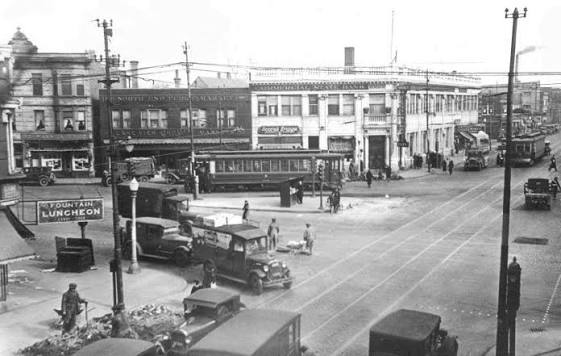
A view of the Armitage-Halsted commercial corner at the district's mid-century peak. Gepperth's Meat Market, open since 1915, is visible at the left edge.
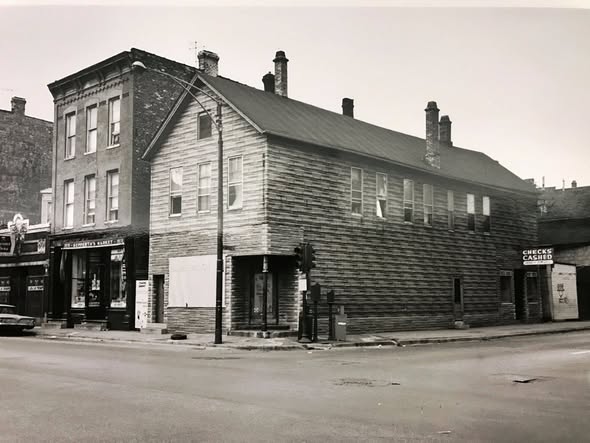
An elevated view looking east along Armitage toward Halsted, with a streetcar at center and early automobiles filling the intersection. A "Fountain Luncheon" sign is visible at lower left.
From horse-drawn trolley to Chicago Landmark, the Armitage-Halsted corridor has anchored RANCH Triangle for over a century.
District History FAQ
The street was originally called Center Street. In 1890, when its horse-drawn trolley line was electrified, the avenue was renamed after Thomas Armitage, an American clergyman and founder of the American Bible Union.
The Armitage El Station opened in 1900 and is one of the oldest train stations in continuous operation in the United States. Its platform overlooks the landmarked Victorian commercial district.
The district was officially designated a Chicago Landmark on February 5, 2003, recognized for its rare intact Victorian streetscape: pressed metal cornices, bay windows, turrets, terra-cotta ornament, and stone patterning unparalleled in the Midwest.
Yes. The terracotta ornament above the entry at 1966 N. Halsted was cast from a mold based on the decoration of architect Louis H. Sullivan, dating to about 1905, when he was still largely unknown. Sullivan went on to become one of the most celebrated architects in American history.
Yes. The corner building at 925 W. Armitage, a general store from 1896 and a hardware store from 1922, operated as a Prohibition-era speakeasy. Its basement connected to adjacent buildings by a secret tunnel used to slip patrons into the Bissell Street alley during police raids. Rumor holds that Al Capone ran a combination tavern and funeral parlor across the street.
Strongin Brothers, Inc. at the corner of Armitage and Seminary in RANCH Triangle was reportedly the original candy cane manufacturer in the city. The company operated out of the neighborhood in the early 20th century.
Cretors Popcorn Company, located at the corner of Racine and Armitage, was reportedly an early inventor of rolling popcorn machines. Charles Cretors is widely credited with creating the first steam-powered popcorn machine in Chicago in the 1880s, a device that gave rise to the familiar street cart popcorn vendor.
According to local lore, Harry Houdini staged an escape from the basement of the old police station located two blocks north of Armitage on Halsted Street. The building is now a video game venue. The story has never been fully documented but has been passed down among longtime neighborhood residents.
Researched by Hallee Patterson, RANCH Historian
These street histories were compiled by our neighborhood historian. Have a correction, an old photograph, or a story to add? Email info@RANCHTriangle.org. We would love to hear from you.